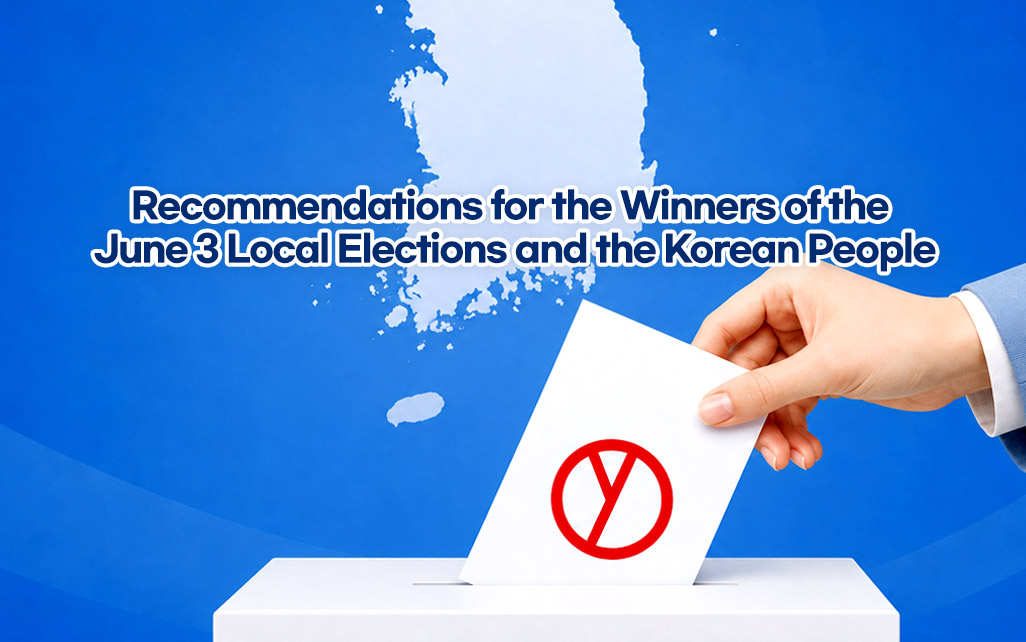
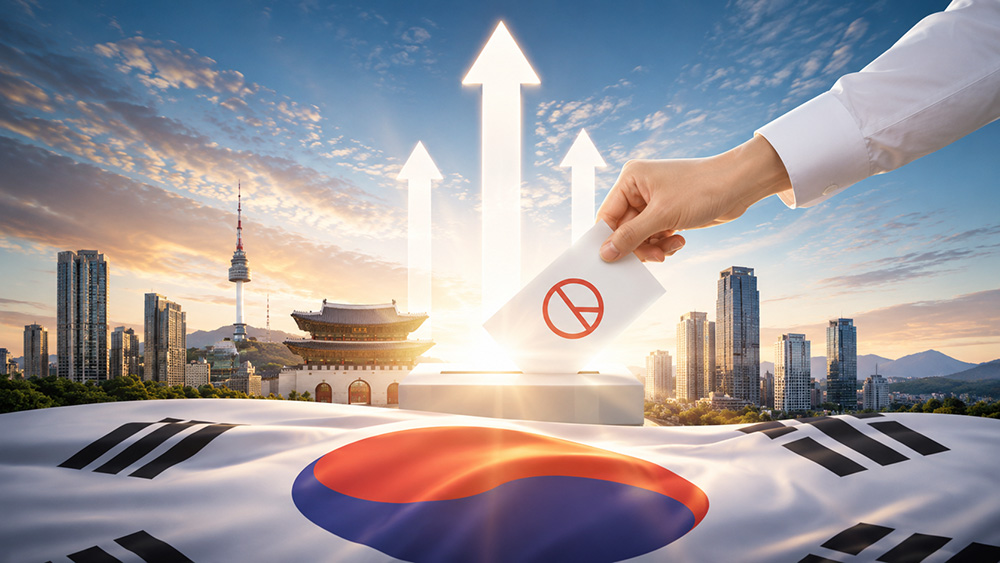
On June 3, nationwide local elections will be held. Elections will take place for 16 metropolitan governors and superintendents of education, as well as mayors, county heads, district chiefs, metropolitan and local council members, and in some regions even National Assembly by-elections. A total of 4,241 public officials will be elected (*1), and voters will cast their ballots on as many as seven or eight separate ballot papers. Nearly ten thousand candidates bow before the people, each pledging devotion to their region and to the nation. The small land of Korea has boiled with election fever, and now some raise a toast to victory while others drink the bitter cup of defeat.
Yet the reality of leadership revealed behind this festival of democracy is far from joyful. With each successive election, politics sinks deeper into a swamp of distrust, and the chasm of conflict grows ever wider. The walls of factional logic and collective selfishness rise higher, while the basic grammar of democracy—dialogue and compromise—fades away. In its place come harsh rhetoric, blatant agitation, and cash-based populism aimed merely at winning votes. Watching so-called leaders themselves take the lead in deepening division, we cannot help but ask: what kind of people should leaders in the Republic of Korea be, and why should they become our leaders?
The Fundamental Virtues of Leaders Preserved Since Ancient Greece and Rome
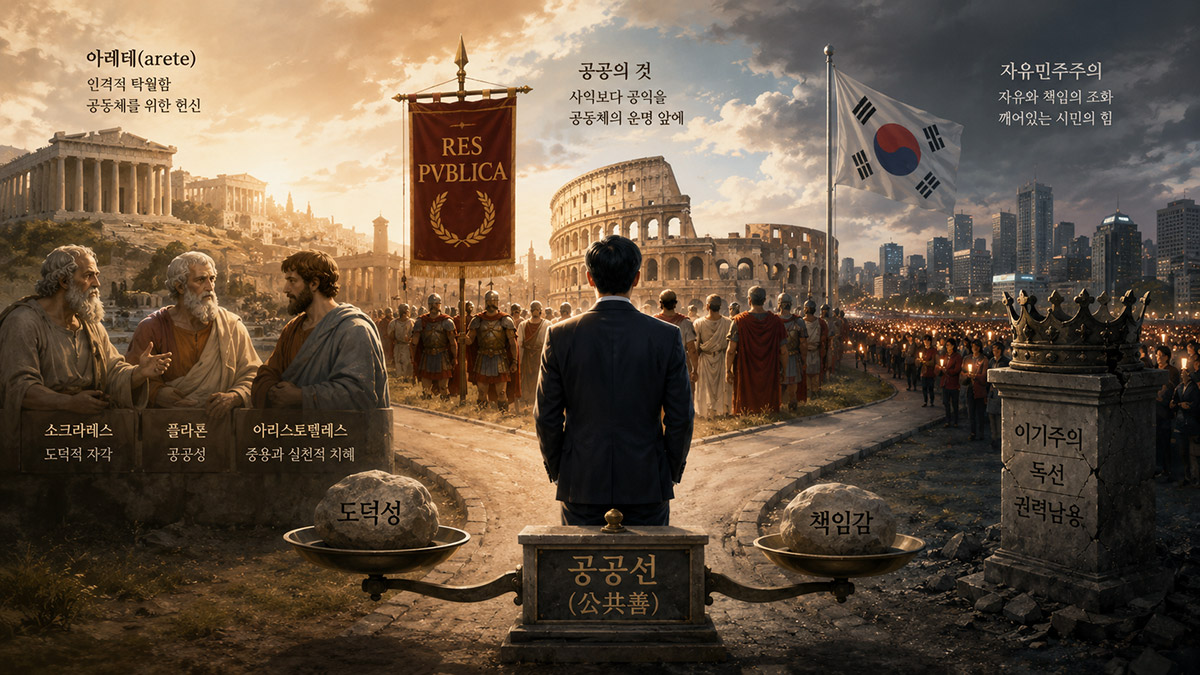
Across all ages and civilizations, the foremost virtue of a leader was never knowledge or technical skill, but character and integrity. The citizens of ancient Athens valued the spirit of “arete.” Originating from the courage to charge into enemy lines, the term came to signify “personal excellence” expressed through a willingness to sacrifice oneself for the community. This spirit, which formed the foundation of Athenian democracy, gained philosophical depth through the wisdom of Athens’ great thinkers. Socrates’ moral self-awareness, Plato’s emphasis on public-mindedness over private desire, and Aristotle’s doctrine of moderation and practical wisdom were all different expressions of this same spirit. The virtue most urgently needed in Korea’s leaders today is precisely this sense of morality and profound responsibility toward the community.
This spirit of devotion also served as the cornerstone of the Roman Empire’s prosperity. Rome, once a small city-state on the Italian peninsula, grew into a great power embracing the Mediterranean world not merely because of military strength or geographical advantages. At its deep root lay the Roman conviction of “res publica”—the public thing. Civic duty and the public spirit of the ruling class, which placed the common good above private interests and the fate of the community above personal ambition, were the moral pillars that made Rome truly Roman.
The liberal democracy we enjoy today is a civilizational achievement painstakingly formed through the tension and harmony between liberalism, which sought to protect individual freedom, and republicanism, which emphasized communal responsibility and the common good. Behind it lay the blood, sweat, and tears of countless people who struggled for centuries against the abuses of power in pursuit of liberty and democracy. Yet freedom can at any moment degenerate into selfishness and license, while the name of republicanism can be distorted into a justification for dogmatism and concentration of power. The crisis now confronting the Republic of Korea lies precisely here. The more the common good is shaken, the heavier becomes the responsibility of leaders to restore it; yet our reality has failed to respond adequately to that expectation.
A Turbulent World Order and a Soil That Fails to Cultivate Leadership
In this civilizational era of great transformation, where AI and robots are rapidly replacing human domains, leadership equipped with the ability to read the times, foresee the future, and guide the nation has become an essential condition for survival. It is often said that “times of turmoil produce heroes,” but if heroes fail to emerge despite turbulent times, the future can only become precarious.
The problem is that such leadership does not arise overnight. Our public education system, which should be nurturing talent, now faces a profound crisis. Rather than awakening creativity and cooperation, it has become trapped in the chains of entrance examinations. Excessive private education is eroding the potential of future generations. The even greater tragedy is that the consciousness of coexistence and mutual survival that sustains a community is weakening. Even the virtues of listening, persuading, and compromising have faded. In a society that fails to teach respect and cooperation, it is no coincidence that politics loses its vision and falls into blind factional confrontation.
For this reason, countries around the world have established their own systems for testing and cultivating leaders in order to prevent unprepared individuals from ascending to power and shaking the destiny of the nation. This is true not only of the United States and Western nations, but even of socialist China, which trains its leaders through rotational assignments and internal verification processes. Yet institutions alone are not enough. History demonstrates this through the Weimar Republic, which, despite possessing a progressive constitution, failed to prevent Hitler’s rise to power through legal procedures. When robust institutions and mature civic consciousness fail to operate together, democracy can open the door to tragedy.
It is often said that “times of turmoil produce heroes,” but if heroes fail to emerge despite turbulent times, the future can only become precarious.
The Hidden Side of Korean Politics: Elites Without Empathy and Activists Without Responsibility
The pathways through which leaders emerge in the Republic of Korea have long been distorted to a grotesque degree. Of course, not all politicians can be lumped together. Broadly speaking, the developmental paths of those who have led Korean politics fall into two extremes.
The first is the elitist path symbolized by “libraries and examination rooms.”
Lacking social sensitivity and skilled only in personal advancement, such individuals use politics not as a space for compromise but as an opportunity to prove to those in power that they are right and others are wrong. Their deficiency in empathy leads them to perceive and process the people’s suffering merely as administrative procedures, ultimately pushing public sentiment away and even shaking the very foundation of the government itself.
The second is the path of radical activism symbolized by “public squares and the streets.”
For those accustomed to the grammar of overthrow and denial, it is difficult to expect the inclusiveness needed to embrace a community or the sense of responsibility required to design the future. Leadership built without the foundational construction of character and integrity is bound to waver, and such figures repeatedly fall into the vicious cycle of relying on the anger of their supporters in order to maintain their positions.
Lack of Reflection in Government and Politics, and Impoverished Human Resource Development
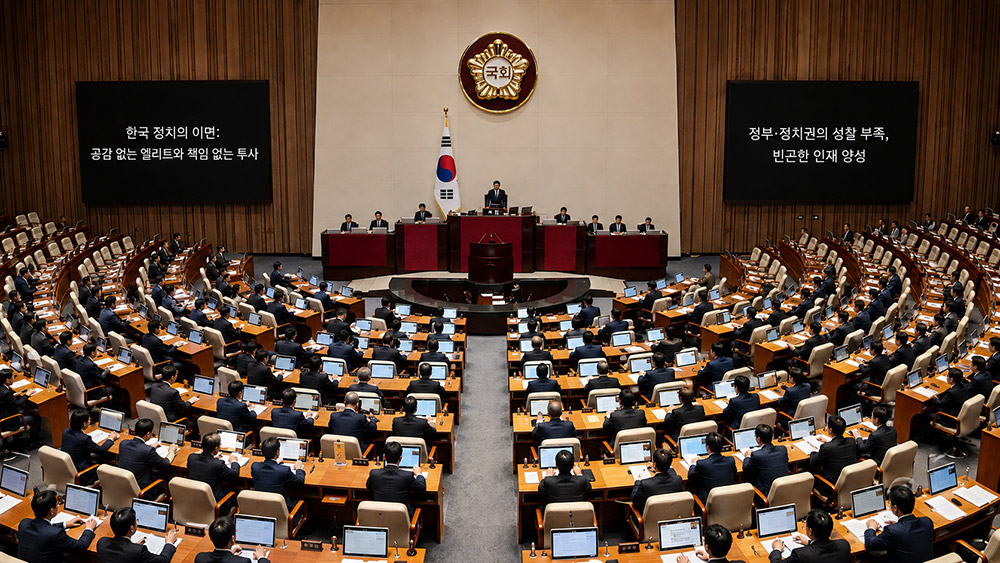
The leadership of the Republic of Korea currently faces a crisis demanding deep reflection. Mid- and long-term planning and talent cultivation policies are woefully inadequate, while leaders remain fixated only on immediate issues, lacking awareness that we stand at a civilizational turning point and remaining trapped within a narrow talent pool centered on “their own people.”
Even more concerning is the paralysis of morality. The language of leaders ought to be a tool for easing conflict and promoting unity, yet recent political rhetoric has become exceedingly coarse and violent. Conduct that approaches everything solely through the logic of victory and defeat is not democratic leadership. What is needed now is not dazzling eloquence, but the “dignity of language,” which is directly connected to character itself. If the President and leaders of both ruling and opposition parties were forced to take back the words they have spoken, they would all be too ashamed to raise their heads—assuming they possess any conscience at all.
Awakening the People Is the True Duty of a Leader
“It is wise citizens who produce wise leaders” is a common belief in electoral democracies. Yet the masses do not awaken on their own. Just as Pericles (*2) of ancient Greece honored the fallen while simultaneously awakening civic pride and responsibility, a true leader must not exploit the anger of the masses but instead guide them toward rational awakening.
To be seduced by sweet promises while ignoring the future burden on public finances is to place a heavy burden upon our children and grandchildren. The essence of leadership lies in awakening citizens swept away by emotional agitation and helping them discern soberly what truly serves the nation’s future and national interest. Yet many believe that no one could ever win an election by doing so. As a result, both candidates and voters stray from the righteous path into crooked alleys, ultimately leading themselves into ruin.
A Proposal to the Winners of the June 3 Local Elections
Now the election is over, and the public servants who will bear responsibility for society have been decided. To those winners now intoxicated by the joy of victory, I ask sternly: are you prepared to devote and sacrifice yourselves for the community? Do you possess the wisdom to maintain balance and achieve harmony amid conflict and division? Election victory is not the end, but the beginning of painful self-discipline.
First, one must remember that politics is not a crown of success but a yoke of responsibility.
Local elections are not stepping stones toward higher office. In the field of grassroots democracy, leaders must feel the suffering of residents as their own and demonstrate collaborative leadership grounded in humility and cooperation.
Second, one must abandon the grammar of hostility and choose the language of coexistence.
Truth can be found even in the voices that opposed you. The ability to converse and listen with dignity is itself leadership. Persuasiveness is judged not by one’s debate opponent, but by those watching from the audience.
Third, reform the paradigm of education.
We must escape the swamp of success-oriented thinking and re-establish principles and direction around “contribution and responsibility.” In particular, elected superintendents of education must put an end to educational systems that encourage the avoidance of responsibility and blind egalitarianism.
In the age of AI, cultivating and exercising one’s unique talents has become more important than ever. Yet such talents must not remain mere tools for personal success; they gain true dignity only when used for the community. Instilling this realization is the very beginning of leadership education.
In Closing: Asking Once Again About the Way of Leadership
Having spent decades in politics witnessing the rise and fall of countless talented individuals, I have never before felt the absence of true leadership as painfully as I do today. There are many positions, yet no true elders; titles are splendid, yet no character worthy of emulation can be seen.
Leaders are not born; they are made. Painful self-discipline, passionate love for the community, and a profound sense of responsibility must come first. We must now move beyond asking “who will win the election” and begin the fundamental discussion of “what kind of character a leader ought to possess.”
A society in which responsibility and devotion prevail, and morality is respected—that is the future image of an advanced Republic of Korea that we should pass on to future generations. Before wishing success to those elected, I sternly urge them toward moral maturity and a heavy sense of responsibility toward the public good. The seat upon which you now sit is merely a chair temporarily lent to you by someone else. Its true owner is the people, the voters. (K)