A History of Success and Its Shadows
However, because these achievements were accomplished in such a compressed manner within a short period of time, they have also produced many side effects. These include excessive competition, materialism, an excessive emphasis on results, the prevalence of illegal and expedient practices, and the emergence of various political, economic, and social conflicts.
The conflicts in our society take countless forms: ideological conflicts between conservatives and progressives amid the reality of the division between North and South Korea; regional conflicts between the Seoul metropolitan area and non-metropolitan areas, and between Yeongnam and Honam; economic conflicts between the rich and poor arising from polarization; generational conflicts; gender conflicts; conflicts between large corporations and small and medium-sized enterprises; conflicts between labor and management and between regular and non-regular workers; and conflicts concerning minorities such as persons with disabilities and immigrants. However, without resolving these conflicts and achieving social integration, it will be difficult to achieve national development or fully enter the ranks of advanced countries. To resolve these problems, not only the political community but all citizens must work together.

Basic Principles of Social Integration
The starting point of social integration is to formulate and implement rational policies that prevent and resolve the various conflicts prevalent in our society. What is needed for this is leadership for social integration on the part of political leaders and senior public officials, as well as a democratic civic consciousness among the people. The following three points are necessary for this purpose.
First, we must create a society in which "law and principles" are firmly upheld.
Social integration cannot be achieved in a society where law and principles are undermined and so-called “law based on public sentiment” and “mob rule” prevail. We must recognize that law and principles are not tools for the socially powerful to dominate, but the foundation of a fair democratic society in which everyone lives together; on this basis, we must correct flawed institutions and practices, eradicate expedient and illegal practices, and create a society in which human dignity and trust are respected in order to achieve social integration.
Second, we must create a society characterized by "communication and harmony" and "dialogue and compromise."
Law and principles are fundamental, but before invoking law and principles, efforts should first be made to resolve problems through dialogue and compromise, even if doing so takes somewhat more time. “Communication and harmony” are means by which our society can resolve all the conflicts and confrontations it faces and move toward social integration. Even if communication and dialogue do not ultimately result in compromise or harmony, the process itself can alleviate conflict and confrontation to some extent.
Third, we must create a society characterized by "sharing and consideration."
Not every problem can be resolved through law and principles, communication and harmony. There may still be people who suffer losses or fall behind. Efforts are needed to compensate for this, and that is what “sharing and consideration” means. This is the path toward social integration by resolving the various inequalities and imbalances in our society and creating a compassionate society. Sharing and consideration are not only for the sake of others; they are also for ourselves and for our community. This is why we must sincerely care for and embrace those who are relatively weak and poor and those who belong to marginalized groups.
The leadership most needed is integrative leadership that achieves social integration through dialogue and compromise, and through sharing and consideration, while taking law and principles as its foundation. This must serve as the basis of national governance.
Advancing Politics and Reforming the Power Structure and Electoral System
To achieve social integration, it is essential to establish an appropriate political system and mode of governance. First, politics must change from a politics of conflict and confrontation to a politics of dialogue and compromise. The current presidential system, derided as an “imperial presidency,” must be changed. The current single five-year-term presidential system fulfilled its historical mission in 1987 by satisfying the public’s desire for the direct election of the president and eliminating concerns about dictatorship arising from prolonged rule.
Instead, the president has come to monopolize excessive power, leading the system to be derided as an imperial presidency. Election campaigns descend into ugly battles concerned solely with victory, and depending on the outcome, the victorious side holds a feast to distribute the spoils of office, while the defeated side bides its time and waits five years for another opportunity. This vicious cycle continues, and presidents often fail to earn respect after leaving office or suffer unfortunate fates. Such phenomena are far removed from social integration. The key to solving the problem lies not in the concentration of power but in its dispersion. To this end, constitutional reform must be discussed, including various reforms to the power structure such as a semi-presidential system or parliamentary cabinet system. Greater national strength can be created not by monopolizing and concentrating power, but by dispersing power and governing the country through dialogue, compromise, and accommodation among those who share that dispersed power.
To this end, the winner-takes-all electoral system must be improved so that the number of seats is proportional to each party’s share of the vote, thereby minimizing wasted votes. For example, under Korea’s single-member constituency system, it is common for a party that receives only around 40 percent of the vote to secure 50 or 60 percent of the seats and exercise absolute authority, which undermines social integration. This irrationality must be corrected. Of course, an essential prerequisite is that institutions and practices must also be improved so that political parties are organized and operated democratically.
Such an example can be found in Germany. In forming governments, coalition governments rather than single-party governments are established without exception. This is because, under Germany’s multiparty system, it is extremely rare for a single party to secure a majority of seats in the Bundestag on its own. Even in 1956, when the general election results made it possible to establish a single-party government, a coalition government was formed to ensure more stable political administration and smooth cooperation with the Bundesrat and the governments of the individual states. Thus, from the establishment of the government to the present, coalitions between multiple parties have been formed without exception. There have even been several grand coalitions between the two largest parties, including parties representing the political right and left. This is because the electoral system allocates seats in proportion to the percentage of public support received by each party, and therefore every party receiving at least 5 percent of the vote can be allocated seats. In any case, coalition government serves as a tool for minimizing conflict.
Although cooperation in Germany is in some respects unavoidable because of the electoral system, the leadership of politicians, especially chancellors, plays an important role.
"For example, Willy Brandt, in practicing politics, always thought not in terms of 'either this or that (entweder oder)', but rather 'both this and that (sowohl als auch)'. Brandt regarded either-or decisions as declarations that no alternative existed and as evidence of political incompetence. He believed that human beings endowed with reason and imagination continually seek successful solutions, and that compromise, so long as it does not conflict with matters of conscience, establishes norms in a democracy."
Representative Areas of Conflict: Inter-Korean Issues and Economic and Social Issues
Regarding the division between North and South Korea, our policies have swung back and forth between the Sunshine Policy and a policy of strong pressure depending on whether the governing political force is progressive or conservative (Germany, by contrast, went through the process of achieving reunification while pursuing its Western and Eastern policies in parallel), and this is a cause of the so-called South-South conflict. Militarily, because North Korea threatens our security, we must maintain the preparedness necessary to suppress any provocation at any time; on the other hand, because North Korea is also our counterpart with whom we must achieve reunification as one people, we must engage in dialogue and cooperation.
The Ministry of National Defense and the Ministry of Unification must each perform different roles from their respective, contrasting positions. Pursuing the Sunshine Policy (engagement policy) must not weaken the roles of the Ministry of National Defense or the National Intelligence Service. These two policies are not alternatives from which only one must be chosen; they must be pursued together in parallel. By doing so, South-South conflict can also be resolved and social integration achieved.
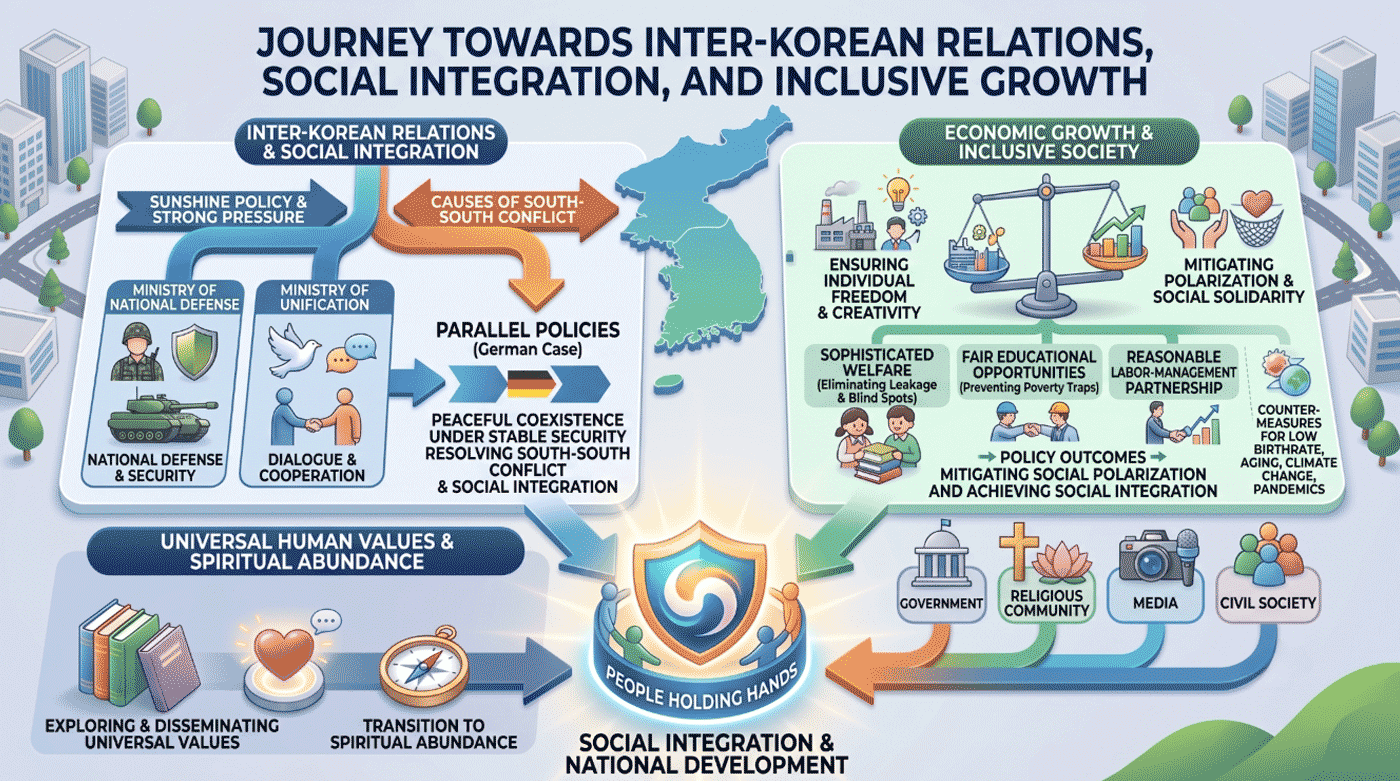
While maximizing growth by guaranteeing competitive economic activity based on individual freedom and creativity to the greatest extent possible, we must also make diverse policy efforts in the areas of welfare, taxation, education, and labor to reduce the harmful effects of polarization through social solidarity that assists those who fail or become marginalized in the process.
First, a sophisticated welfare system must be designed and implemented so that those in need receive the amount of support they require, thereby preventing both welfare leakage and gaps in welfare coverage. Fair and equal educational opportunities must be guaranteed, and in particular, a system must be designed to ensure that no one is deprived of educational opportunities because of poverty. Policy efforts are also needed to establish rational labor-management relations, create mutually beneficial partnerships between labor and management, and resolve conflicts among workers arising from the so-called dual structure of the labor market. Alongside measures addressing the low birth rate and aging population, responses to newly emerging challenges such as climate change and infectious diseases are also urgent tasks. The achievements of these policies will contribute to social integration.
In addition, through the exploration and dissemination of universal humanistic values, efforts should be made to enable our society to move from spiritual impoverishment toward spiritual richness. Not only the government, but also religious communities, the media, and civil society should actively participate in this endeavor.