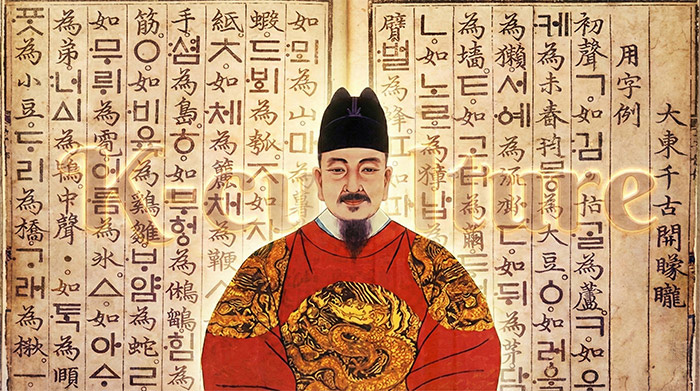
Hangul-Built K-Culture and
the Culture of Chinese Characters (Hanja)
The most creative invention in Korean history is Hangul, a jewel of human civilization. King Sejong was the only supreme ruler in human history to personally create a writing system out of compassion for the hardships of common people, and such an event will likely never happen again. Indeed, Japanese scholar Hideki Noma described Hangul as “a miracle of writing” in his book The Birth of Hangul. Today’s globally captivating K-culture owes much to this miracle called Hangul.
Yet what lost its luster because of Hangul was the so-called culture of Chinese characters (Hanja). Hanja does not belong to China alone but to East Asia as a whole, and through it we cultivated our own civilization over several thousand years. Chinese characters contain wisdom: for instance, the character in (人), completed with just two strokes, seems to signify that a human being lives by supporting and leaning on others. When a person approaches a tree, it becomes hyu (休), rest; when living alongside mountains, it becomes seon (仙), an immortal or fairy. It is regrettable that we now perceive hyu and seon merely as sounds, stripped of their layered meaning.
Person and Human Being (人間)
As people grow, most live as members of a large collective called society, and such beings are called human beings (人間). The term combines person (人) with between (間). What meaning lies within this? What exists between people, and how are the most important human relationships within society formed? These questions ultimately converge on the fundamental inquiry, “What is a human being?” In humanity’s pursuit of answers, religion, philosophy, and the natural sciences emerged, shaping the societies we inhabit today.
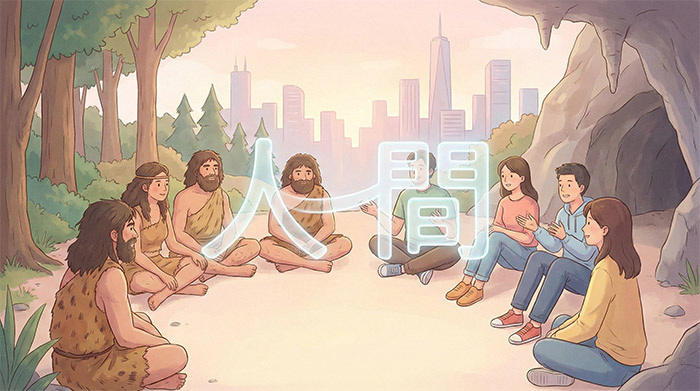
Humanity initially formed groups to secure more food through cooperation and to protect itself. Cooperation requires communication, likely rooted in facial expressions, gestures, and primitive language. With the advent of agriculture about ten thousand years ago, group sizes expanded and villages and cities formed. Within these societies, language—unique to humans—advanced further. Yet language that vanishes the moment it is spoken posed many problems. The enduring value expressed in the saying “A man’s word is worth a thousand pieces of gold” remains just as relevant today.
The Intellectual Revolution Brought About by Writing and Books

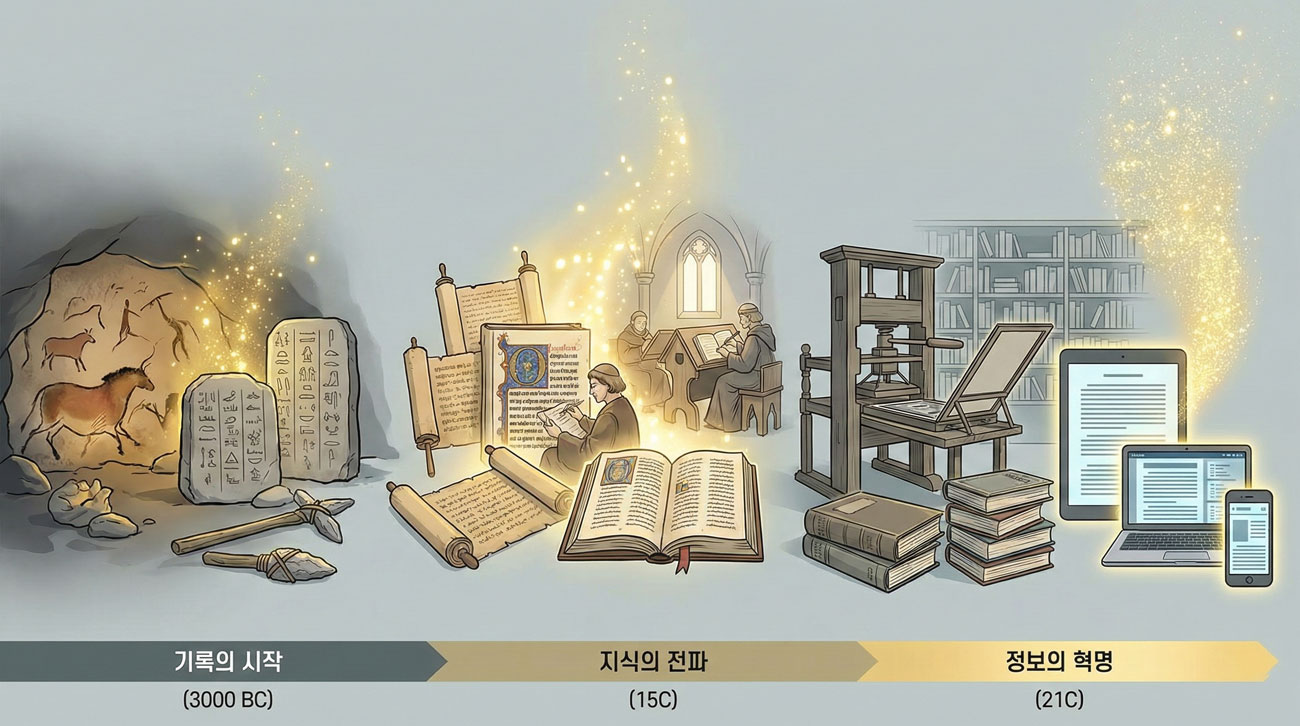
For most of human history, what lay between people was nothing more than evaporating language. However, the emergence of writing about five thousand years ago enabled revolutionary human progress. A common trait of early centers of civilization, including the Yellow River basin in China, is that they were places where writing began. Knowledge and information once transmitted only orally accumulated across generations through writing, allowing humanity to progress from the Stone Age to the Bronze Age and then to the Iron Age. With both language and writing positioned between people, a new era emerged.
Knowledge once recorded with brush or pen on a few sheets of paper grew in volume and took the form of books. Valuable books were reproduced into multiple copies, all by hand. As a result, books were expensive treasures reserved for royalty and aristocrats. The transmission and diffusion of knowledge were thus extremely limited, and humanity lived this way for thousands of years.
The invention of metal movable type about five hundred years ago enabled mass publication of books, triggering yet another revolution. Martin Luther’s 1517 publication criticizing the sale of indulgences became the starting point of the Reformation. Isaac Newton’s Principia, published in 1687, opened the world of natural science and later became a seed of the Industrial Revolution. As books came to occupy a central place between humans, humanity experienced a profound intellectual revolution marked by radical changes in thinking, knowledge systems, and worldviews. Over the past five centuries, the world has transformed dramatically.
The Intellectual Revolution Led by AI
Since the widespread introduction of computer technology some fifty years ago, another intellectual revolution has been unfolding. The limitless expansion of knowledge and information driven by digital networks, the collapse of disciplinary boundaries, and the erosion of authority are social transformations we are already experiencing. We stand at a civilizational turning point, one that compels us to revisit even the question, “What is a human being?”

This intellectual revolution has been accelerating in recent years as artificial intelligence—AI—has come to occupy the space between people. Until now, language and books have served as simple tools that connect human beings; AI, however, is an entity capable of producing knowledge on its own and spreading it further. AI is already playing a striking role not only in art and music—fields long regarded as uniquely human—but also in the writing of novels. AI has moved beyond the status of a tool and is now emerging as a companion to human life.
The Tangled Reality of Korean Education
Education, in essence, is the making of human beings. As humanity itself is changing, education must change accordingly. Education is the key that opens the door to a better future; when education fails to offer hope, society inevitably loses vitality and collapses. No one would deny that education contributed significantly to Korea’s miraculous development over the past half century. Yet when asked about the future, concern abounds. A nation that prospered through education now seems to be declining because of it. Our education system feels like a hopelessly tangled ball of yarn. Despite successive governments consistently pledging education reform over several decades, no fundamental transformation has ever been achieved.
As with many forms of technological civilization, aviation advanced dramatically through warfare. During World War II, the most formidable weapons were air force fighter planes that dropped bombs from the sky, and Germany therefore devoted considerable effort to shooting down American aircraft. For the U.S. Air Force, losses caused by anti-aircraft fire were particularly severe, leading to an urgent focus on developing more resilient fighter planes. To this end, the U.S. military examined all aircraft that had been hit by anti-aircraft fire yet managed to return safely. These investigations revealed that most bullet damage was concentrated around the wings. Accordingly, early efforts focused on reinforcing those areas with additional armor. This approach, however, was soon fundamentally revised when it became clear that aircraft struck in the engine section had already crashed and thus never returned to be examined in the first place.
Perhaps our education policies similarly focus only on visible bullet holes. Examples include the Moon Jae-in administration’s abolition of autonomous private high schools and the Yoon Suk Yeol administration’s removal of so-called “killer questions” from the College Scholastic Ability Test (CSAT). How will the Lee Jae-myung administration’s proposal to create ten Seoul National Universities be judged in the future? Genuine education reform requires long-term planning and patient execution. Education is not a subject of revolution but of gradual change, and it must transcend political administrations. Only then can fears that Korea will fall because of education become mere groundless anxiety.
The CSAT: The First Knot to Untangle
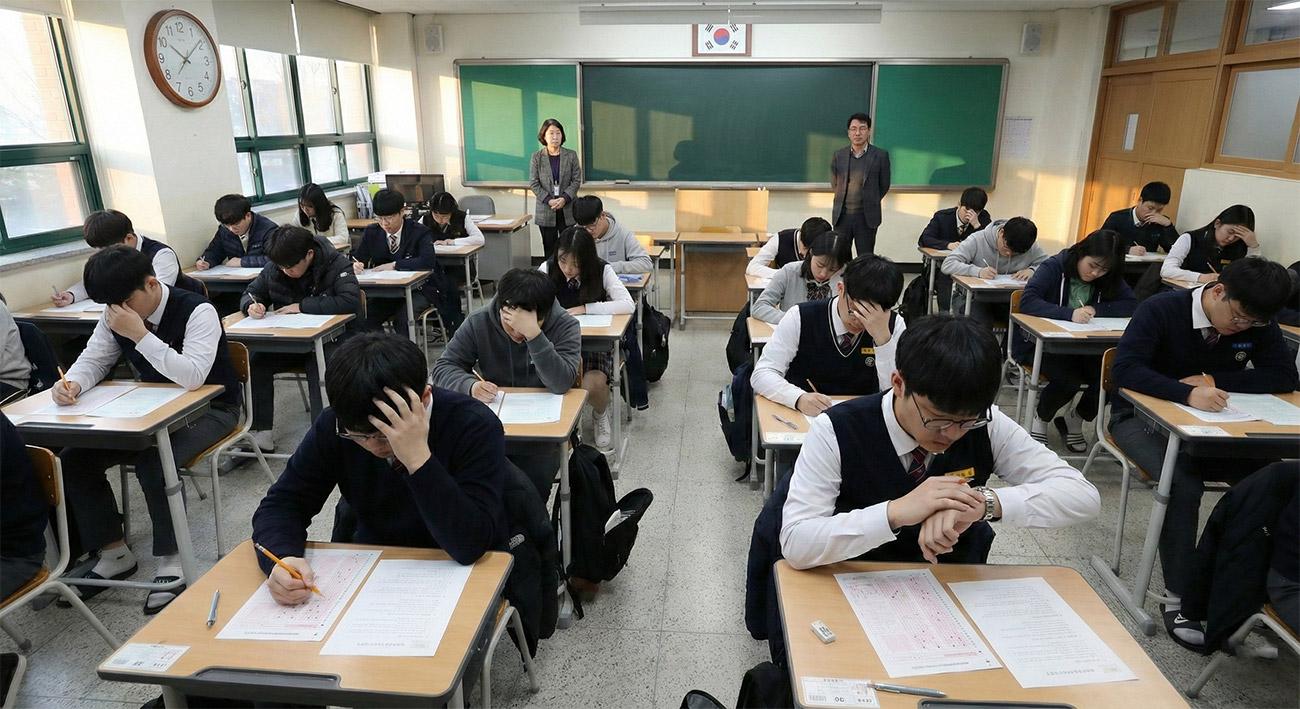
"It is believed to be fair because everyone accepts the results, yet the losses are greater."
What is the first knot that must be untangled in our deeply knotted education system? In any organization, members value what is rewarded, and for students this means performing well on exams. University admission depends on grades, and thus the nature of exam design shapes the type of talent produced. Exams dominate education absolutely.
From this perspective, the College Scholastic Ability Test—which gathers over 500,000 students in a single day to choose one correct answer repeatedly—is the greatest obstacle in our education system. It is believed to be fair because everyone accepts the results, yet the losses are greater. Such evaluation methods were effective in a developing society pursuing industrialized nations, but they must now be reformed.
Future talent requires creativity, which does not involve selecting the correct answer to a given problem but rather identifying problems themselves. CSAT training that focuses on choosing one answer from five options depletes students’ creativity. It would be worth increasing writing questions by five percent annually over ten years, ultimately achieving an equal balance between subjective and objective questions. Moreover, cultivating critical thinking, broad perspectives, cooperation, and empathy—qualities necessary for living with others in society—is absolutely essential.
University Autonomy: Another Knot to Untangle

In 1970, more than one million children were born in Korea; in 2020, the number fell to 270,000. Even if all were to attend university, half of existing universities would need to close. Many regional private universities are already on the path to bankruptcy due to declining enrollment.
Although the decline in the school-age population was long anticipated, making universities partly responsible, the more fundamental cause lies in excessive government regulation that standardized and tightly controlled universities. Both public and private universities are subject to detailed oversight by the Minister of Education, from tuition levels to the size of official seals. Autonomy entails responsibility; underperforming universities should naturally exit the education market. Yet Korean universities cannot even dissolve at will.
Universities are the intellectual centers of the future, and autonomy is their lifeblood. Beyond administrative independence, universities must autonomously determine education, research, personnel, finance, and academic operations. Universities themselves must take the lead in securing autonomy, with government and society providing support. Korea’s future depends on it.