Where Is the United States Heading?
South Korea is joining the ranks of advanced nations at a pace that even it could hardly have predicted. This was made possible by the security and economic support provided by the United States during the Cold War, and after its end, by riding the wave of globalization led by the United States. Yet while Korea was advancing along this path of success, enormous fissures and tectonic magma of transformation had already been building beneath the very foundations of American power and the international order.
In particular, since the 2008 Global Financial Crisis originating in New York, the United States has begun to lose its growth momentum relative to major emerging economies, notably China. America’s share of the global economy, which stood at roughly 50 percent immediately after World War II, had declined to 25 percent by 2025. During the same period, the share of manufacturing in the U.S. economy fell to one-third of its former level. Only a minority of those employed in manufacturing—once a major engine of job creation—moved into high-income financial services and Big Tech, while the rest became part of a relatively lower-income class. The relative decline of the United States in the world economy and the widening of inequality at home began to reshape America itself.
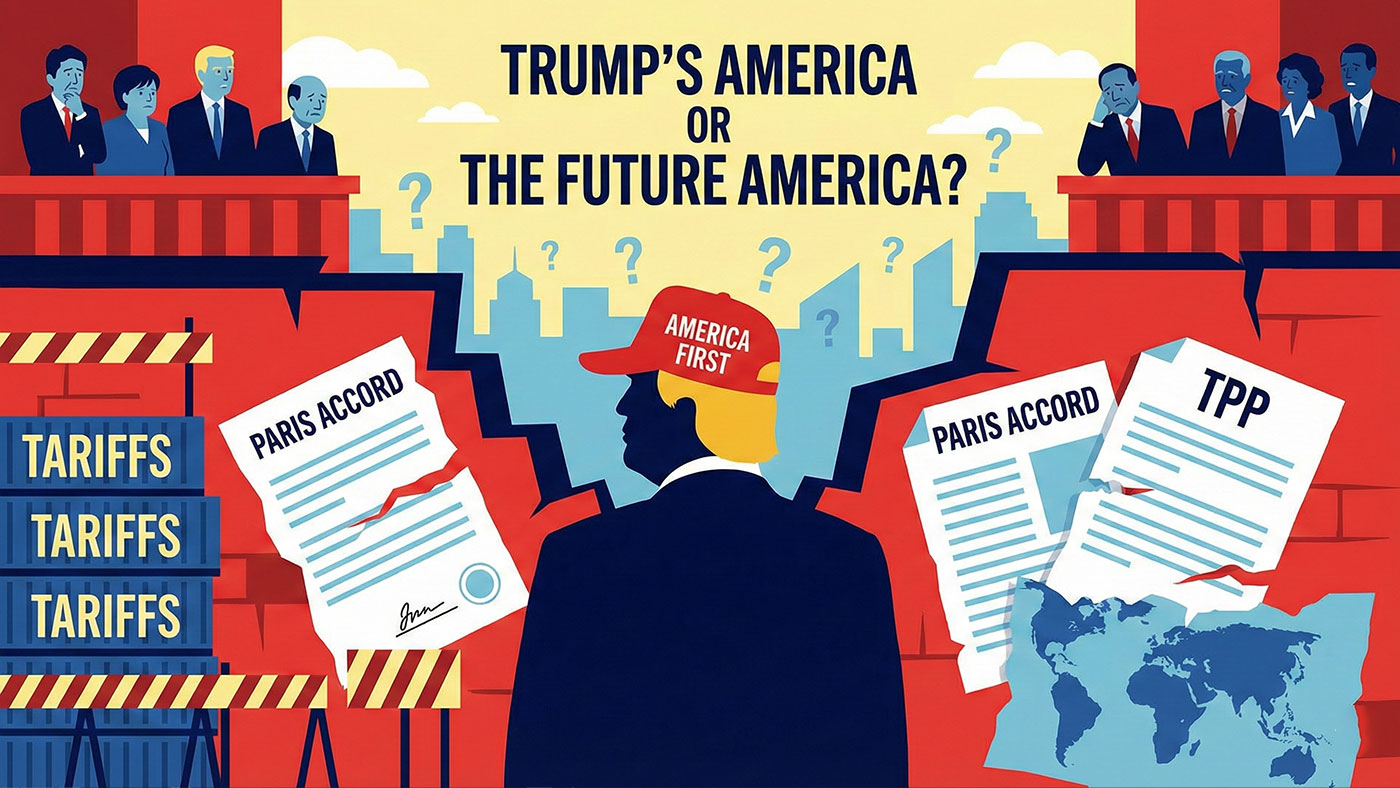
This transformation widened the gap between America’s external commitments and its capacity to fulfill them—the so-called “Lippmann gap.” The long-simmering current of “America First” surfaced wearing the cap of Trumpism. Under the second Trump administration, tariffs have been deployed as weapons to force the reshoring of manufacturing to the United States, while existing international agreements centered on the United Nations are being dismantled. The world is assessing whether this runaway phenomenon will remain merely “Trump’s America” or become “America’s future.” Following the U.S. Supreme Court’s February 20 ruling that indiscriminate tariffs are unlawful, attention is now focused on what choice voters will make in the November midterm elections.
The problem is that even if the American public rejects “Trump’s America,” it will be difficult to return to the pre-Trump era. There are limits to changing the prevailing pattern of producing less while consuming more. Since the Biden administration, the United States has already exhibited regressive tendencies: state-led industrial policy, forced reshoring of jobs, reduced external engagement and shifting of defense burdens, and selective implementation of international agreements. Whoever occupies the White House will find it difficult to resist the temptation to resolve internal contradictions externally. Policy change may amount more to changing clothes than changing the body itself.
For a considerable period ahead, the United States is likely to frame its security policy around three pillars: (1) minimizing external commitments, (2) containing the risks of intervention, and (3) reducing the costs of engagement. In practical terms, this signals a return to a “sphere-of-influence” international order. Broad outlines are emerging: the Americas and the Pacific; China and East Asia; Russia and Central Asia; Western Europe as its own regional bloc. The 2025 U.S. National Security Strategy (NSS) and the 2026 National Defense Strategy (NDS) both emphasize “strategic stability” between the United States and China, and between the United States and Russia. The implicit message is clear: “Let us mutually respect each great power’s core security domain.” Into whose core security domain does the Korean Peninsula fall?
How Is East Asia Moving?
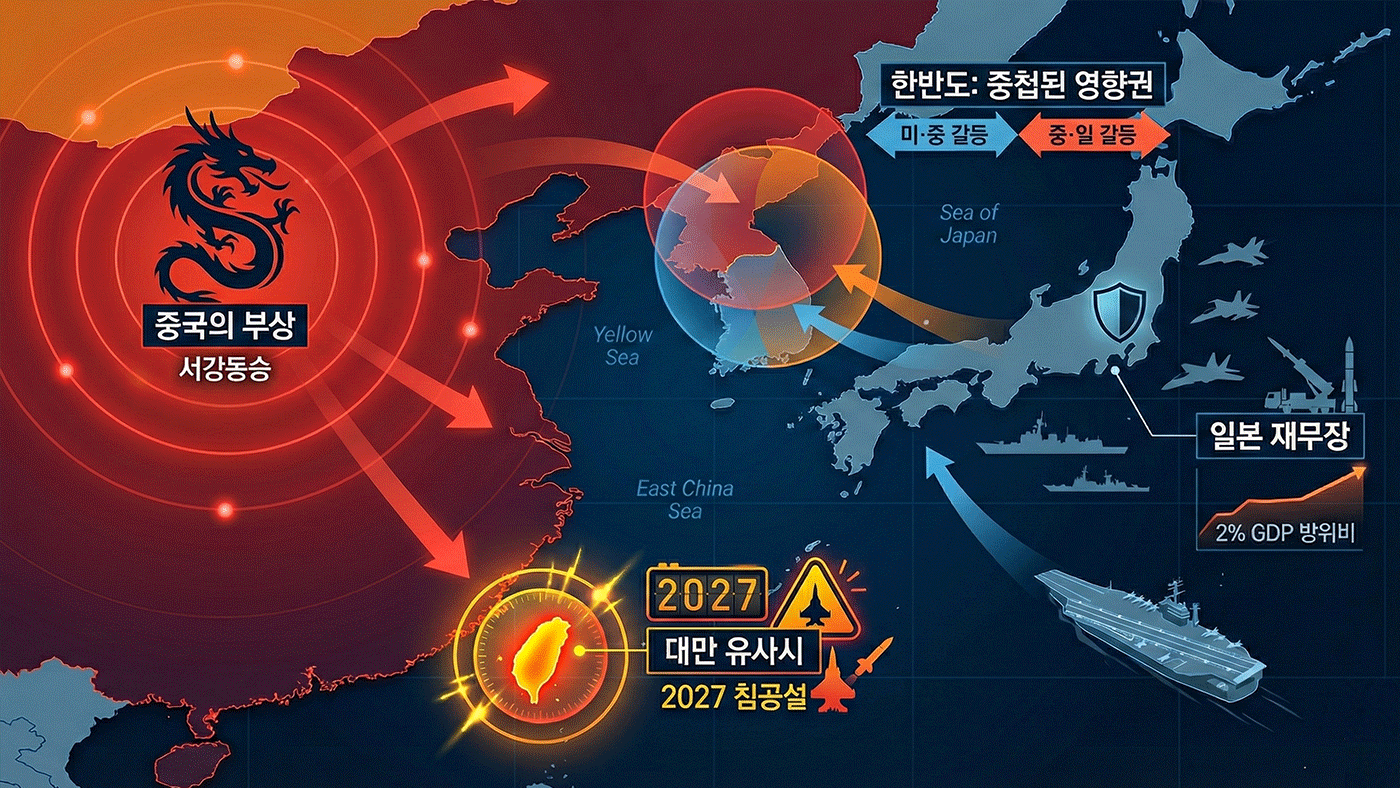
China has recently invoked the phrase “the right side of history.” After the end of the Cold War, it was the United States that first mobilized this discourse—rooted in Hegelian and Marxian thought—encouraging authoritarian states to move toward the “right side of history.” Since the rise of Xi Jinping, however, China has advanced a worldview grounded in Sinocentric thought and the notion of “the East rising and the West declining,” urging neighboring countries to join the “right side of history” led by China.
China is under expansion of its nuclear capabilities without joining U.S.–Russia strategic arms reduction agreements. A renewed global nuclear arms race is underway. Amid speculation of a possible Chinese invasion of Taiwan in 2027, Xi Jinping is removing moderate leaders within the military. Following remarks by the Japanese prime minister concerning the possibility of Japanese military intervention in a Taiwan contingency, the volatility of China–Japan tensions has become even less likely to subside.
Japan, recognizing the shifts in the United States and China, delivered an unprecedented landslide victory in the February general election to the conservative Liberal Democratic Party led by Prime Minister Takaichi. Japan plans to raise defense spending to 2 percent of GDP by next year. This represents a doubling within five years from the 1 percent benchmark maintained until 2022. As domestic debate on military expansion tilts decisively in one direction, Japan’s rearmament could unfold in a pattern of “gradually, then suddenly.”
Japan has already established an integrated operational command in 2025 and begun preparing for wartime readiness. This reflects both preparation for a potential vacuum left by the United States in East Asia and a desire to expand national autonomy constrained by dependence on U.S. security guarantees. This is why the possibility of Germany’s emergence as a hegemonic power—now discussed in Europe—resonates anew in East Asia.
Whether through a ceasefire or formal conclusion, the war in Ukraine is likely to end in a manner somewhat favorable to Russia. Strategic calculations in Washington—seeking to leverage Russia vis-à-vis Western Europe and China—also play a significant role. To the extent that Russia gains breathing room, it will exert a certain influence on the Korean Peninsula. On February 11, Foreign Minister Lavrov declared before the Duma, “North Korea’s nuclear weapons guarantee its prosperity, and sanctions should no longer be imposed.” Military cooperation between Russia and North Korea, along with advanced technology transfers, manpower exchanges, and support in energy and food, may well become prolonged.
Meanwhile, North Korean leader Kim Jong-un, facing domestic and external challenges stemming from the stagnation of his flagship “nuclear–economic parallel development” policy, declared in late 2023 a shift toward an “enemy state-to-state relationship.” From the outset, an illegally nuclear-armed state had little prospect of escaping sanctions, making the parallel development strategy unrealistic. However, as U.S.–China rivalry intensifies and the Russia–Ukraine war becomes prolonged, North Korea has now secured overlapping security backing and economic support from China and Russia.
Amid these developments, South Korea is attempting a Korean Peninsula peace strategy combining U.S.–North Korea dialogue with inter-Korean dialogue. However, North Korea—unable to relinquish its nuclear arsenal—adjusts the threshold of dialogue like the fond of Tantalus, keeping counterparts perpetually thirsty. It also knows that any agreement reached with the United States could be revoked at any time. As a result, South Korea’s repeated invocation of “peaceful coexistence” risks becoming little more than survival under the “threat of North Korea’s nuclear weapons” and the “power of the U.S. nuclear umbrella.”
The Path Korea Must Take
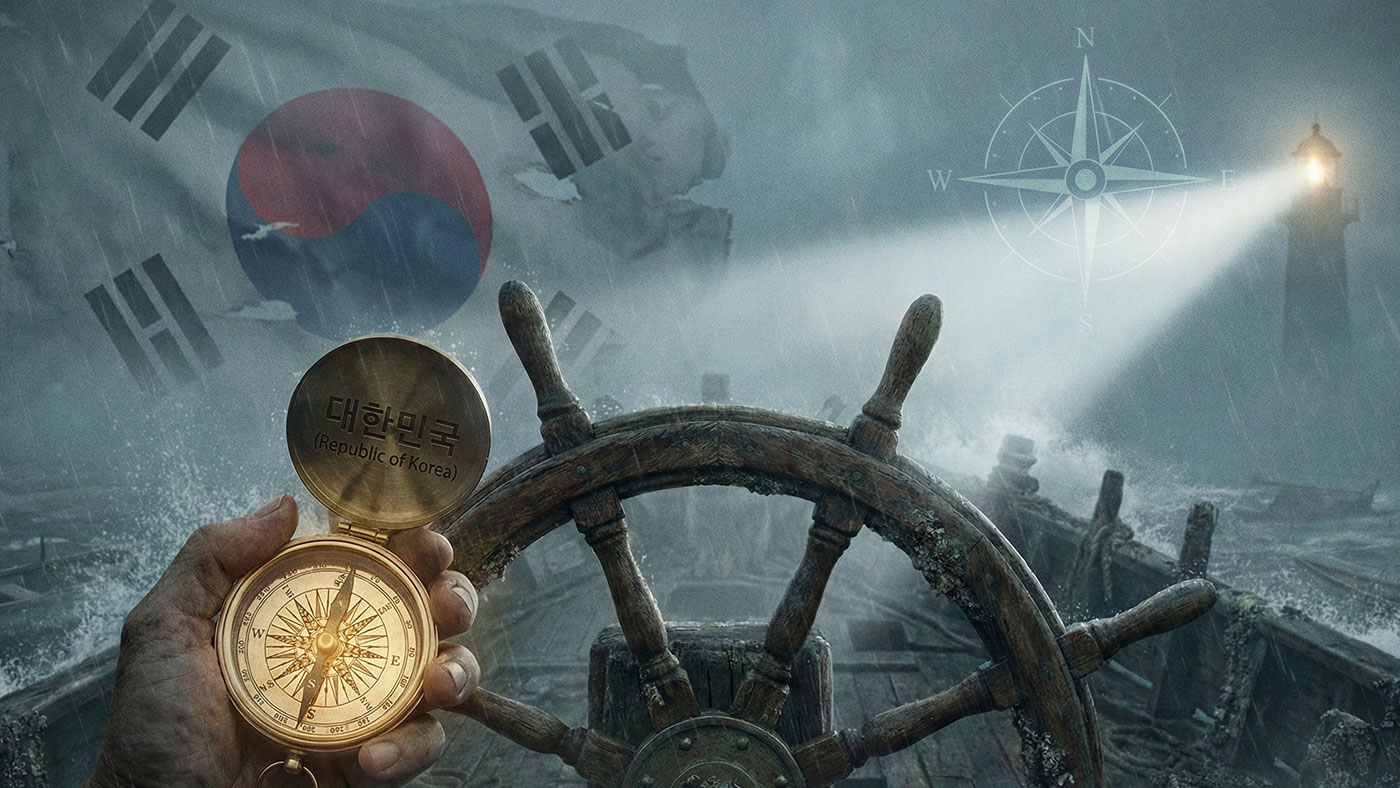
If the United States were to fold its security umbrella even now, South Korea would be swept into turbulent waters without a life jacket. For a country whose national destiny has long rested on American security guarantees, their possibility of both quantitative and qualitative change is now clearly before us. Faced with U.S. pressure wielding tariffs as a weapon, South Korea pledged investments comparable in scale to those of the European Union—whose economy is ten times larger—and Japan, whose economy is 2.5 times larger (including government-supported private investment). Korea’s vulnerable negotiating environment, rooted in its absolute security dependence on the United States, further constrained its position.
"For survival, prosperity, and a “dignified peace,”
the time has come when strategic autonomy is urgently needed."
For survival, prosperity, and a “dignified peace,” the time has come when strategic autonomy is urgently needed. Only if national policy and action demonstrate flexibility can Korea navigate global disorder and open a path to the future. Above all, it must reduce excessive security dependence on the United States and ease economic overreliance on both the United States and China. In economic affairs, the government’s primary role is to support rational private-sector decision-making through policy and institutional frameworks.
In the security domain, by contrast, government policy directly shapes reality. First, the ROK–U.S. alliance must evolve into a self-reliant partnership. Two conditions are required. One is overcoming the nuclear imbalance between North and South. Some argue that South Korea should develop its own nuclear arsenal to establish balance. However, as long as the U.S. nuclear umbrella remains in operation, this is not a viable path. The political, security, and economic costs would be too great. A more realistic alternative is to secure a peaceful nuclear capability foundation within the Nuclear Non-Proliferation Treaty (NPT) framework and maintain preparedness for contingencies.
The other condition is securing operational control competence over South Korean forces. This would shift the security architecture on the Korean Peninsula from “U.S.–North Korea” to “South Korea–North Korea.” As the United States itself emphasizes, this transition of operational control should occur on the premise of the ROK–U.S. alliance. Transferring operational control does not mean the withdrawal of U.S. forces. Achieving these two objectives requires presidential leadership capable of consolidating national consensus while commanding negotiations with Washington with resolve and focus.
Second, a fundamental shift in approach toward unification policy and inter-Korean relations is necessary. Whether through agreement or absorption, setting “unification” itself as an explicit objective paradoxically distances its realization and constrains South Korea’s external autonomy. Unification should be conceived not as a blueprint but as a possible outcome arising from living as “normal neighbors.” By maintaining objectives—“denuclearization” and “unification”—that no neighboring country currently regards as feasible, South Korea has placed itself in a perpetually subordinate position.
South Korea should build peaceful nuclear capabilities comparable to those of Japan or Germany, while telling North Korea, “We will not interfere; live with your nuclear weapons if you must.” That is the path to stability and coexistence. As Thomas Schelling suggested, the posture must be one of “assurance and deterrence”: “If you do not step forward, we will not fire; but if you do, we will.” Today, power is replacing agreement as the foundation of peace. The United States under Trump and China under Xi Jinping, as well as Germany and Japan—long constrained by the legacy of defeat in World War II—all now emphasize power.
Establishing peaceful nuclear capability, securing operational control competence, and defining a “normal neighbor” relationship between North and South grounded in the principles of assurance and deterrence—these are the three foundations of power that South Korea must build.